Blackberries
Play References:
[Falstaff]
Give you a reason on compulsion!--if reasons were as plentiful
as Blackberries, I would give no man a reason upon
compulsion,
Henry IV Part 1, act ii, sc. 4
[Falstaff]
Shall the blessed sun of heaven prove a micher and eat
Blackberries?
Henry IV Part 1, act ii, sc. 4
[Thersites]
That same dog-fox Ulysses is not proved worth a Blackberry.
Troilus and Cressida, act v, sc. 4
[Rosalind]
There is a man . . . . hangs odes upon Hawthorns and elegies
on Brambles.
As You Like it, act iii, sc. 2
Garden group discussion on Shakespeare’s use of plant:
Botanical Name(s) of varieties common in Shakespeare’s England:
Rubus fructicosus
Description:
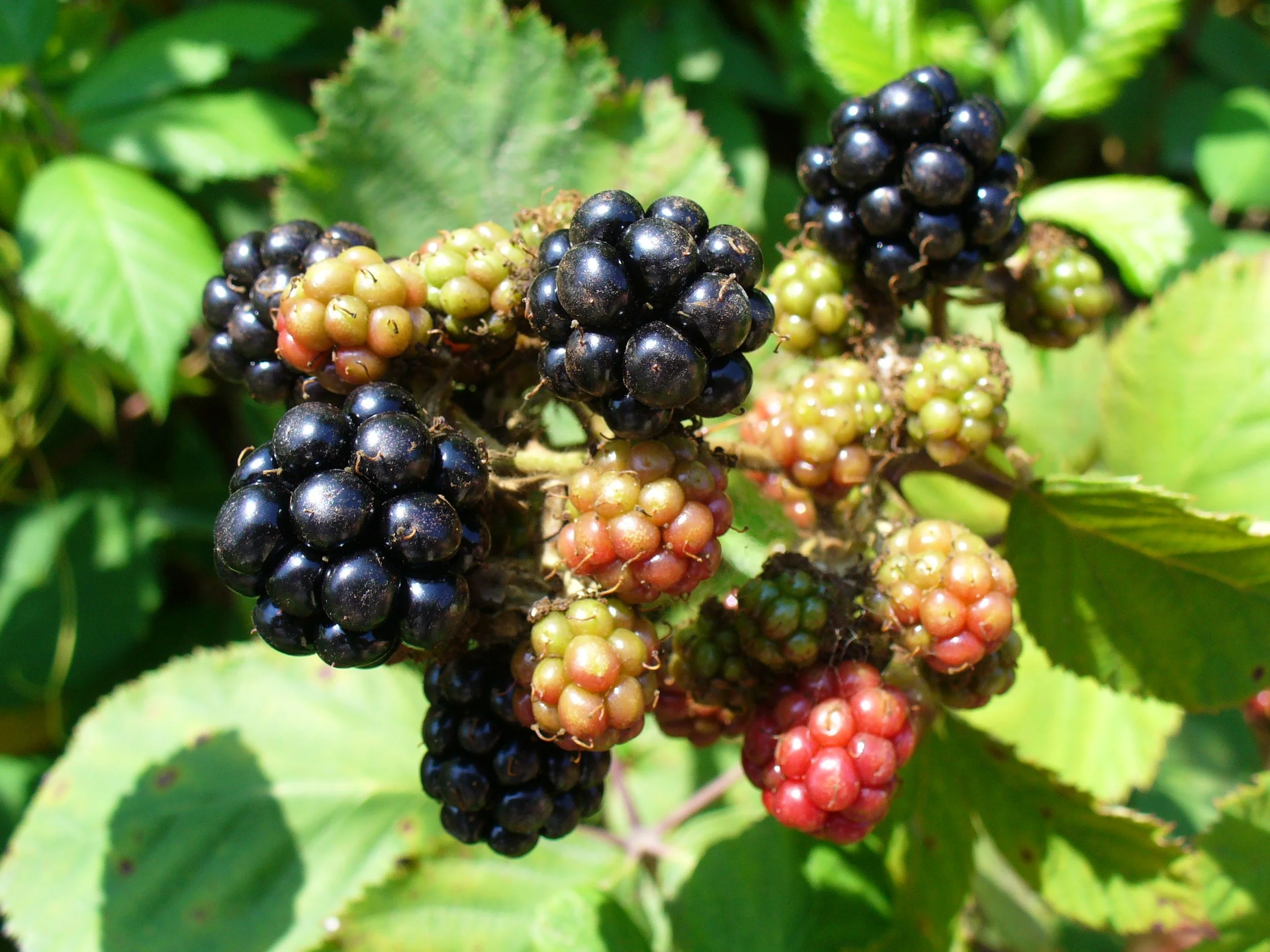
The Blackberry, or Bramble, growing in every English hedge-row, is too well known to need description. Its blossoms, as well as its fruits, both green and ripe, may be seen on the bush: at the same time, a somewhat unusual feature, not often met with in other plants.
The name of the bush is derived from brambel, or brymbyl, signifying prickly. We read of it as far back as the days of Jonathan, when he upbraided the men of Shechem for their ingratitude to his father's house, relating to them the parable of the trees choosing a king, the humble bramble being finally elected, after the olive, fig-tree and vine had refused the dignity. The ancient Greeks knew Blackberries well, and considered them a remedy for gout.
Opinions differ as to whether there is one true Blackberry with many aberrant forms; or many distinct types. Professor Babington divides the British Rubi into forty-one species, or more.
(credit: A Modern Herbal, Volumes 1 & 2 by Margaret Grieve)
Garden Use:
Medicinal | Ornamental
Growing Notes:
Exerpt from Ellacombe:
BLACKBERRIES
I here join together the tree and the fruit, the Bramble (Rubus fruticosus) and the Blackberry. There is not much to be said for a plant that is the proverbial type of a barren country or untidy cultivation, yet the Bramble and the Blackberry have their charms, and we could ill afford to lose them from our hedgerows. The name Bramble originally meant anything thorny, and Chaucer applied it to the Dog Rose--
"He was chaste and no lechour,
And sweet as is the Bramble flower
That bereth the red hepe."
But in Shakespeare's time it was evidently confined to the Blackberry-bearing Bramble.
There is a quaint legend of the origin of the plant which is worth repeating. It is thus pleasantly told by Waterton: "The cormorant was once a wool merchant. He entered into partnership with the Bramble and the bat, and they freighted a large ship with wool; she was wrecked, and the firm became bankrupt. Since that disaster the bat skulks about till midnight to avoid his creditors, the cormorant is for ever diving into the deep to discover its foundered vessel, while the Bramble seizes hold of every passing sheep to make up his loss by stealing the wool."
As a garden plant, the common Bramble had better be kept out of the garden, but there are double pink and white-blossomed varieties, and others with variegated leaves, that are handsome plants on rough rockwork. The little Rubus saxatilis is a small British Bramble that is pretty on rockwork, and among the foreign Brambles there are some that should on no account be omitted where ornamental shrubs are grown. Such are the R. leucodermis from Nepaul, with its bright silvery bark and amber-coloured fruit; R. Nootkanus, with very handsome foliage, and pure white rose-like flowers; R. Arcticus, an excellent rockwork plant from Northern Europe, with very pleasant fruit, but difficult to establish; R. Australis (from New Zealand), a most quaint plant, with leaves so depauperated that it is apparently leafless, and hardy in the South of England; and R. deliciosus, a very handsome plant from the Rocky Mountains. There are several others well worth growing, but I mention these few to show that the Bramble is not altogether such a villainous and useless weed as it is proverbially supposed to be.