Bay Trees
Play References:
[Captain]
'Tis thought the King is dead; we will not stay.
The Bay-trees in our country are all wither'd.
Richard II_, act ii, sc. 4
[Bawd]
Marry come up, my dish of chastity with Rosemary and Bays!
Pericles_, act iv, sc. 6
[The Vision]
Enter, solemnly tripping one after another,
six personages, clad in white robes, wearing on their heads garlands of Bays, and golden vizards on their faces, branches of Bays or Palms in their hands.
Henry VIII_, act iv, sc. 2
Garden group discussion on Shakespeare’s use of plant:
Botanical Name(s) of varieties common in Shakespeare’s England:
Laurus nobilis
Common Name(s):
Sweet Bay | True Laurel | Bay
Description:
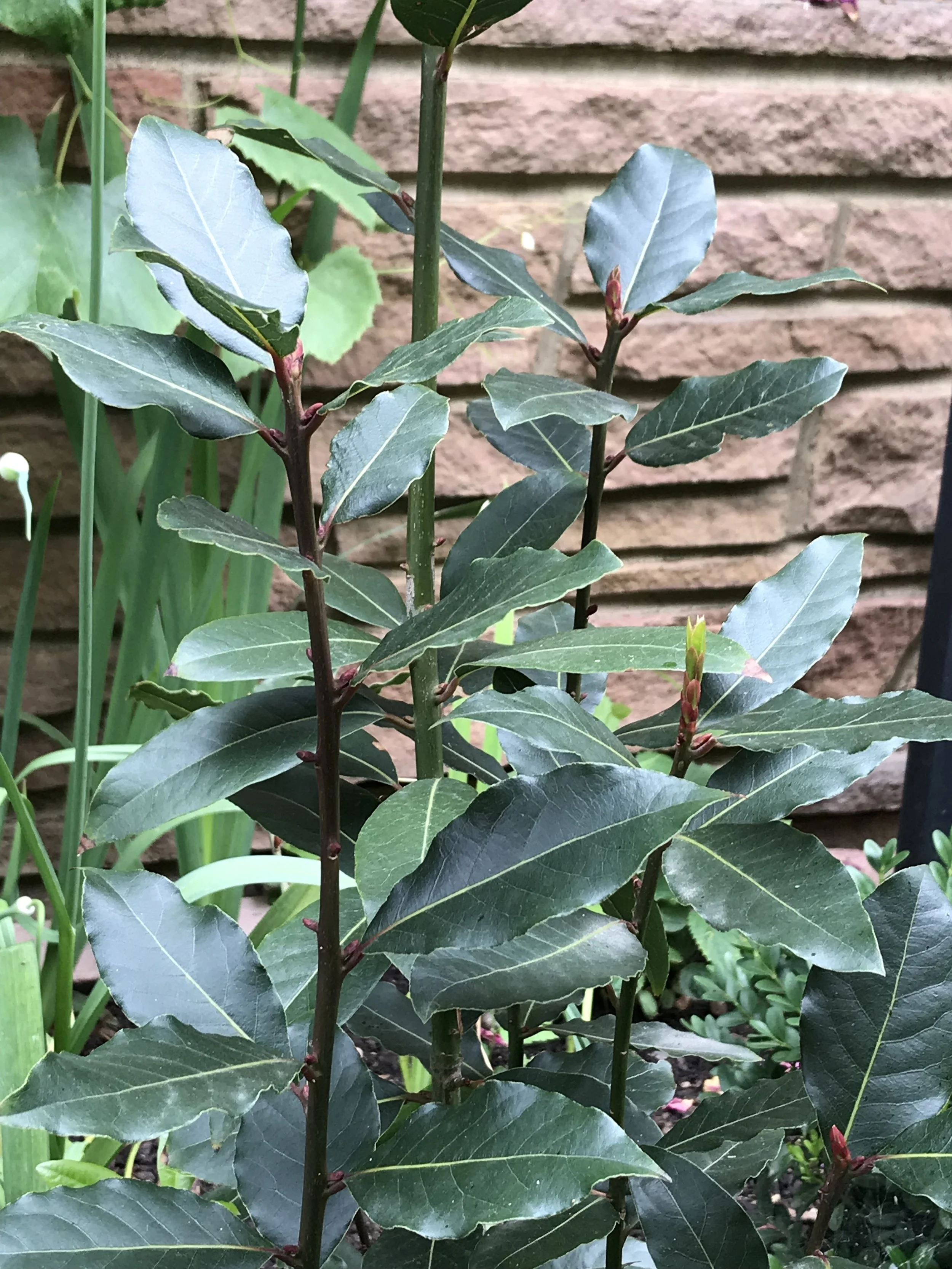
The Sweet Bay is a small tree, growing in Britain to a height of about 25 feet, but in warmer climates reaching as much as 60 feet. The smooth bark may be olive-green or of a reddish hue. The luxurious, evergreen leaves are alternate, with short stalks, lanceolate, 3 to 4 inches long, the margin smooth and wavy. They are thick, smooth, and of a shining, dark green colour. The flowers are small, yellow and unisexual, and grow in small clusters. The shrub has been cultivated in Britain since the sixteenth century. It is the source of the ancients' crowns and wreaths for heroes and poets, and the modern term of 'bachelor,' given for degrees, is probably derived from bacca-laureus, or laurel-berry, through the French bachelier.
The Delphic priestesses are said to have made use of the leaves. It grows well under the shade of other trees if they are not too close, and is useful in evergreen plantations. The leaves are much used in cookery for flavouring. They are often packed with stick liquorice or dried figs. They are used fresh, and may be gathered all the year round.
The volatile oil is sometimes used in perfumery.
The dried, black, aromatic berries come from Provence, Spain, Italy and Morocco. They are ovoid, and the kernel of the seed is loose.
The wood is sweet-scented, and is used for marqueterie work.
Onguent de Laurier is prepared from the oil with axonge and the colouring and scenting principles of the leaves and fruit.
(credit: A Modern Herbal, Volumes 1 & 2 by Margaret Grieve)
Garden Use:
Medicinal | Ornamental
Growing Notes:
h
Exerpt from Ellacombe:
BAY
It is not easy to determine what tree is meant in these passages. In the first there is little doubt that Shakespeare copied from some Italian source the superstition that the Bay trees in a country withered and died when any great calamity was approaching. We have no proof that such an idea ever prevailed in England. In the second passage reference is made to the decking of the chief dish at high feasts with garlands of flowers and evergreens. But the Bay tree had been too recently introduced from the South of Europe in Shakespeare's time to be so used to any great extent, though the tree was known long before, for it is mentioned in the Anglo-Saxon Vocabularies by the name of Beay-beam, that is, the Coronet tree;[32:1] but whether the Beay-beam meant our Bay tree is very uncertain. We are not much helped in the inquiry by the notice of the "flourishing green Bay tree" in the Psalms, for it seems very certain that the Bay tree there mentioned is either the Oleander or the Cedar, certainly not the Laurus nobilis.
The true Bay is probably mentioned by Spenser in the following lines--
"The Bay, quoth she, is of the victours born,
Yielded them by the vanquisht as theyr meeds,
And they therewith doe Poetes heads adorne
To sing the glory of their famous deeds."
Amoretti--Sonnet xxix.
And in the following passage (written in the lifetime of Shakespeare) the Laurel and the Bay are both named as the same tree--
"And when from Daphne's tree he plucks more Baies
His shepherd's pipe may chant more heavenly lays."
Christopher Brooke--Introd. verses
to BROWNE'S Pastorals.
In the present day no garden of shrubs can be considered complete without the Bay tree, both the common one and especially the Californian Bay (Oreodaphne Californica), which, with its bright green lanceolate foliage and powerful aromatic scent (to some too pungent), deserves a place everywhere, and it is not so liable to be cut by the spring winds as the European Bay.[32:2] Parkinson's high praise of the Bay tree (forty years after Shakespeare's death) is too long for insertion, but two short sentences may be quoted: "The Bay leaves are of as necessary use as any other in the garden or orchard, for they serve both for pleasure and profit, both for ornament and for use, both for honest civil uses and for physic, yea, both for the sick and for the sound, both for the living and for the dead; . . . so that from the cradle to the grave we have still use of it, we have still need of it."
The Bay tree gives us a curious instance of the capriciousness of English plant names. Though a true Laurel it does not bear the name, which yet is given to two trees, the common (and Portugal) Laurel, and the Laurestinus, neither of which are Laurels--the one being a Cherry or Plum (Prunus or Cerasus), the other a Guelder Rose (Viburnum).[33:1]
FOOTNOTES:
[32:1] "The Anglo-Saxon Beay was not a ring only, or an armlet: it was also a coronet or diadem. . . . The Bays, then, of our Poets and the Bay tree were in reality the Coronet and the Coronet tree."--COCKAYNE, _Spoon and Sparrow_, p. 21.
[32:2] The Californian Bay has not been established in England long enough to form a timber tree, but in America it is highly prized as one of the very best trees for cabinet work, especially for the ornamental parts of pianos.
[33:1] For an interesting account of the Bay and the Laurels, giving the history of the names, &c., see two papers by Mr. H. Evershed in "Gardener's Chronicle," September, 1876.