Bilberry
Play References:
[Pistol]]
Where fires thou find'st unraked and hearths unswept,
There pinch the maids as blue as Bilberry--
Our radiant Queen hates sluts and sluttery. The Merry Wives of Windsor, act v, sc. 5
Garden group discussion on Shakespeare’s use of plant:
Botanical Name(s) of varieties common in Shakespeare’s England:
Vaccinium myrtillus
Common Name(s):
Heathberry | Whortleberry
Description:
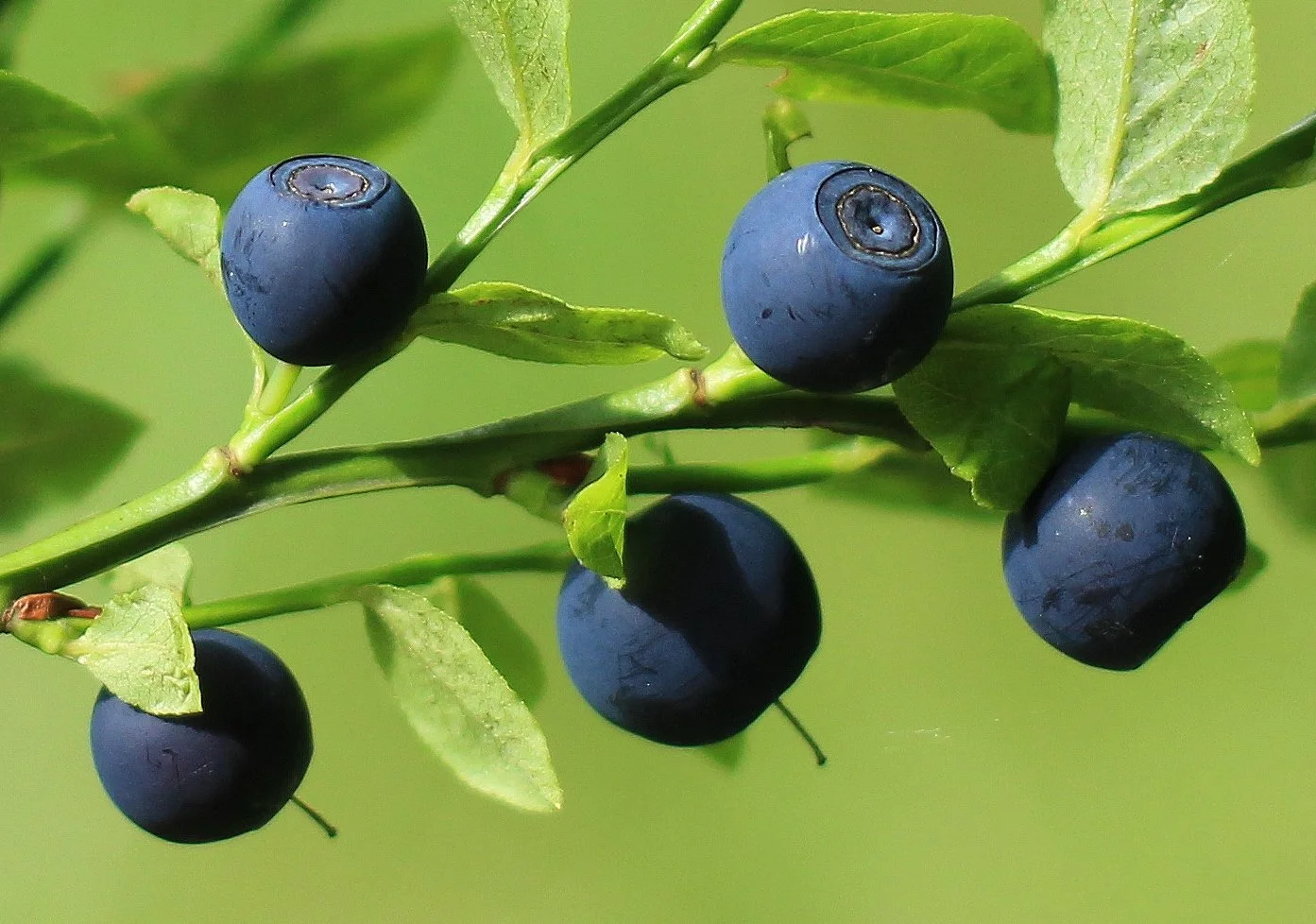
V. myrtillus grows abundantly in heathy and mountainous districts, a small branched shrub, with wiry angular branches, rarely over a foot high, bearing globular wax-like flowers and black berries, which are covered when quite ripe with a delicate grey bloom, hence its name in Scotland, 'Blea-berry,' from an old North Countryword, 'blae,' meaning livid or bluish. The name Bilberry (by some old writers 'Bulberry') is derived from the Danish 'bollebar,' meaning dark berry. There is a variety with white fruits.
Bilberries flourish best on high grounds, being therefore more abundant in the north and west than in the south and east of England: they are absent from the low-lying Cambridgeshire and Suffolk, but on the Surrey hills, where they are called 'Hurts,' cover the ground for miles.
The fruit is globular, with a flat top, about the size of a black currant. When eaten raw, they have a slightly acid flavour. When cooked, however, with sugar, they make an excellent preserve. Gerard tells us that 'the people of Cheshire do eate the black whortles in creame and milke as in these southern parts we eate strawberries.' On the Continent, they are often employed for colouring wine.
Owing to its rich juice, the Bilberry can be used with the least quantity of sugar in making jam: half a pound of sugar to the pound of berries is sufficient if the preserve is to be eaten soon. The minuteness of the seeds makes them more suitable for jam than currants.
The leaves can be used in the same way as those of UvaUrsi. The fruits are astringent, and are especially valuable in diarrhoea and dysentery, in the form of syrup. The ancients used them largely, and Dioscorides spoke highly of them. They are also used for discharges, and as antigalactagogues. A decoction of the leaves or bark of the root may be used as a local application to ulcers, and in ulceration of the mouth and throat.
The fruit is helpful in scurvy and urinary complaints, and when bruised with the roots and steeped in gin has diuretic properties valuable in dropsy and gravel. A tea made of the leaves is also a remedy for diabetes if taken for a prolonged period.
(credit: A Modern Herbal, Volumes 1 & 2 by Margaret Grieve)
Garden Use:
Medicinal | Ornamental
Growing Notes:
Exerpt from Ellacombe:
BILBERRY
The Bilberry is a common British shrub found on all mossy heaths, and very pretty both in flower and in fruit. Its older English name was Heathberry, and its botanical name is Vaccinium myrtillus. We have in Britain four species of Vaccinium: the Whortleberry or Bilberry (V. myrtillus), the Large Bilberry (V. uliginosum), the Crowberry (V. vitis idæa), and the Cranberry (V. oxycoccos). These British species, as well as the North American species (of which there are several), are all beautiful little shrubs in cultivation, but they are very difficult to grow; they require a heathy soil, moisture, and partial shade.