Bachelor’s Button
Play References:
[Hostess]
What say you to young Master Fenton? he capers, he dances, he
has eyes of youth, he writes verses, he speaks holiday, he
smells April and May; he will carry't, he will carry't; 'tis
in his Buttons; he will carry't.
The Merry Wives of Windsor, act iii, sc. 2The canker galls the infants of the Spring
Too oft before their Buttons be disclosed.
Hamlet, act i, sc. 3
Garden group discussion on Shakespeare’s use of plant:
Botanical Name(s) of varieties common in Shakespeare’s England:
Centaurea Cyanus
Cornflower
Description:
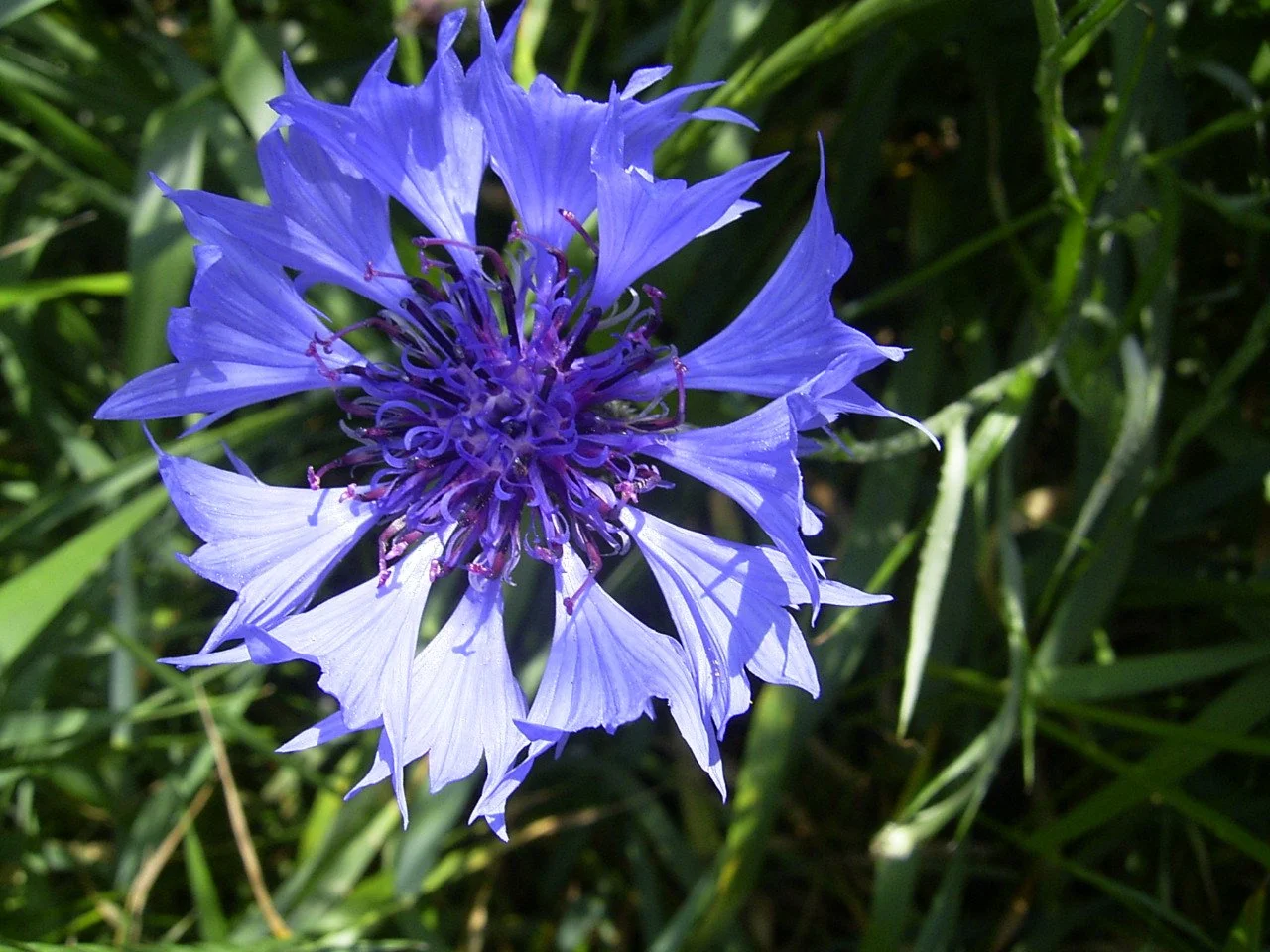
In the wild condition it is fairly common in cultivated fields and by roadsides. The stems are 1 to 3 feet high, tough and wiry, slender, furrowed and branched, somewhat angular and covered with a loose cottony down. The leaves, very narrow and long, are arranged alternately on the stem, and like the stem are covered more or less with white cobwebby down that gives the whole plant a somewhat dull and grey appearance. The lower leaves are much broader and often have a roughly-toothed outline. The flowers grow solitary, and of necessity upon long stalks to raise them among the corn. The bracts enclosing the hard head of the flower are numerous, with tightly overlapping scales, each bordered by a fringe of brown teeth. The inner disk florets are small and numerous, of a pale purplish rose colour. The bright blue ray florets, thatform the conspicuous part of the flower, are large, widely spread, and much cut into.
The flowers are the part used in modern herbal medicine and are considered to have tonic, stimulant and emmenagogue properties, with action similar to that of Blessed Thistle.
(credit: A Modern Herbal, Volumes 1 & 2 by Margaret Grieve)
Garden Use:
Medicinal | Ornamental
Growing Notes:
Exerpt from Ellacombe:
BACHELOR'S BUTTON
"Though the Bachelor's Button is not exactly named by Shakespeare, it is believed to be alluded to in this passage; and the supposed allusion is to a rustic divination by means of the flowers, carried in the pocket by men and under the apron by women, as it was supposed to retain or lose its freshness according to the good or bad success of the bearer's amatory prospects."[27:1]
The true Bachelor's Button of the present day is the double Ranunculus acris, but the name is applied very loosely to almost any small double globular flowers. In Shakespeare's time it was probably applied still more loosely to any flowers in bud (according to the derivation from the French _bouton_). Button is frequently so applied by the old writers--
"The more desire had I to goo
Unto the roser where that grewe
The freshe Bothum so bright of hewe.
* * * * *
But o thing lyked me right welle;
I was so nygh, I myght fele
Of the Bothom the swote odour
And also see the fresshe colour;
And that right gretly liked me."
Romaunt of the Rose.
And by Shakespeare--
The canker galls the infants of the Spring
Too oft before their Buttons be disclosed.
Hamlet_, act i, sc. 3
FOOTNOTES:
[27:1] Mr. J. Fitchett Marsh, of Hardwicke House, Chepstow, in "The Garden." I have to thank Mr. Marsh for much information kindly given both in "The Garden" and by letter.