Apricot
Play References:
[Titania]
Be kind and courteous to this gentleman;
Hop in his walks, and gambol in his eyes;
Feed him with Apricocks and Dewberries,
With purple Grapes, green Figs, and Mulberries.
Midsummer Night's Dream, act iii, sc. 1
[Gardener]
Go, bind thou up yon dangling Apricocks,
Which, like unruly children, make their sire
Stoop with oppression of their prodigal weight.
Richard II, act iii, sc. 4
[Palamon]
Would I were,
For all the fortunes of my life hereafter,
Yon little tree, yon blooming Apricocke;
How I would spread and fling my wanton armes
In at her window! I would bring her fruit
Fit for the gods to feed on.
Two Noble Kinsmen, act ii, sc. 2
Garden group discussion on Shakespeare’s use of plant:
Botanical Name(s) of varieties common in Shakespeare’s England:
Prunus Armeniaca
Description:
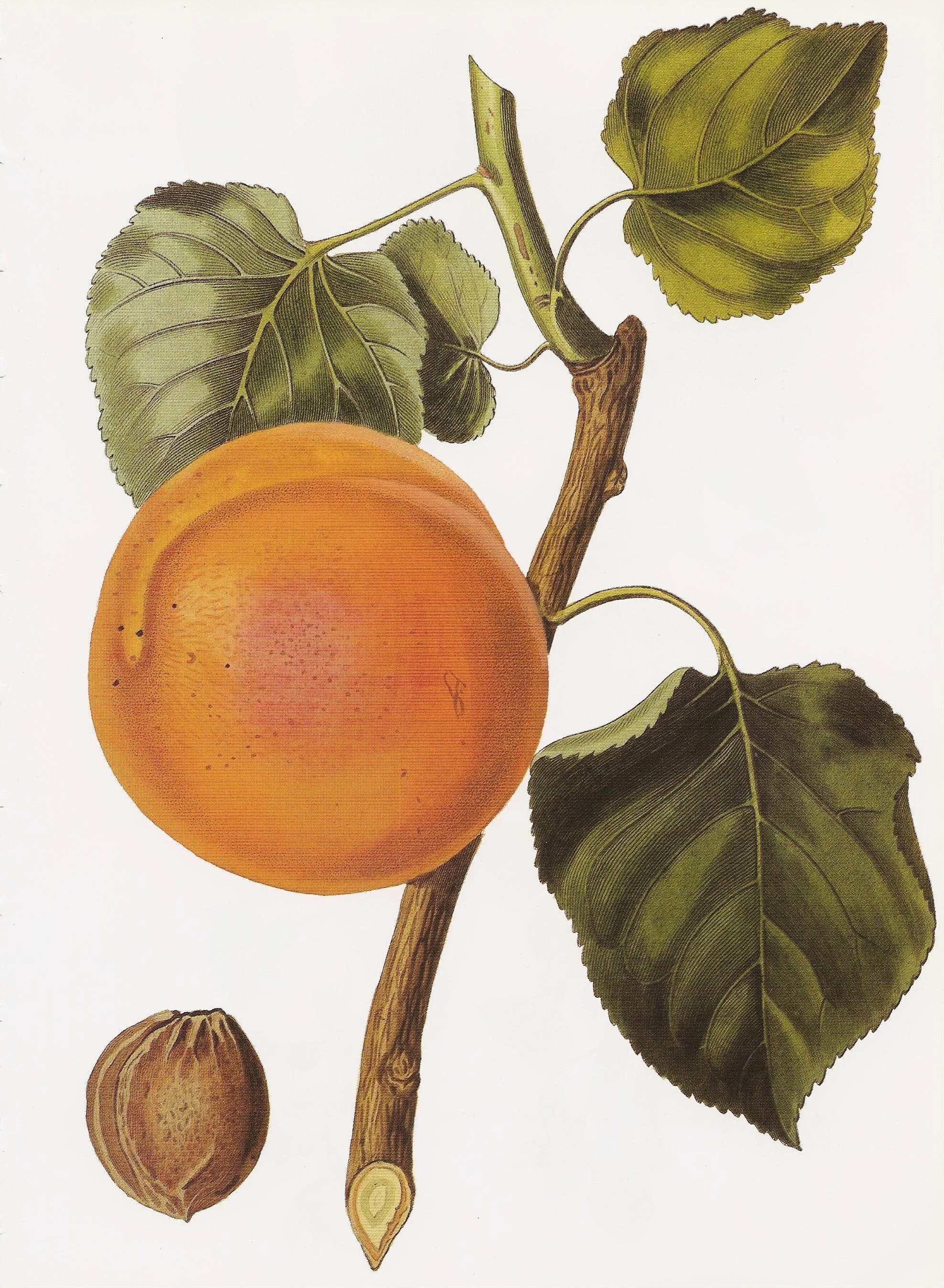
A hardy tree, bearing stone fruit, closely related to the peach. The leaves are broad and roundish, with pointed apex; smooth; margin, finely serrated; petiole 1/2 inch to an inch long, generally tinged with red. The flowers are sessile, white, tinged with the same dusky red that appears on the petiole, with five regular sepals and petals and many stamens, and open very early in the spring. The fruit, which ripens end of July to mid-August, according to variety, is a drupe, like the plum, with a thin outer, downy skin enclosing the yellow flesh (mesocarp), the inner layers becoming woody and forming the large, smooth, compressed stone, the ovule ripening into the kernel, or seed. As a rule in Britain, the fruit rarely ripens unless the tree is trained against a wall; when growing naturally, it is a medium-sized tree. It is propagated by budding on the musselplum stock. A great number of varieties are distinguished by cultivators. Large quantities of the fruit are imported from France. The kernels of several varieties are edible and in Egypt, those of the Musch-musch variety form a considerable article of commerce. Like those of the peach, apricot kernels contain constituents similar to those of the bitter almond: they are imported in large quantities from Syria and California and are oftenused by confectioners in the place of bitter almonds, which they so closely resemble as to be with difficulty distinguished.
It is cultivated generally throughout temperate regions. Introduced into England, from Italy, in Henry VIII's reign.
(credit: A Modern Herbal, Volumes 1 & 2 by Margaret Grieve)
Garden Use:
Culinary
Growing Notes:
Exerpt from Ellacombe:
APRICOTS
Shakespeare's spelling of the word "Apricocks" takes us at once to its derivation. It is derived undoubtedly from the Latin præcox or præcoquus, under which name it is referred to by Pliny and Martial; but, before it became the English Apricot it was much changed by Italians, Spaniards, French, and Arabians. The history of the name is very curious and interesting, but too long to give fully here; a very good account of it may be found in Miller and in "Notes and Queries," vol. ii. p. 420 (1850). It will be sufficient to say here that it acquired its name of "the precocious tree," because it flowered and fruited earlier than the Peach, as explained in Lyte's "Herbal," 1578: "There be two kinds of Peaches, whereof the one kinde is late ripe, . . . the other kinds are soner ripe, wherefore they be called Abrecox or Aprecox." Of its introduction into England we have no very certain account. It was certainly grown in England before Turner's time (1548), though he says, "We have very few of these trees as yet;"[23:1] but the only account of its introduction is by Hakluyt, who states that it was brought from Italy by one Wolf, gardener to King Henry the Eighth. If that be its true history, Shakespeare was in error in putting it into the garden of the queen of Richard the Second, nearly a hundred years before its introduction.[24:1]
In Shakespeare's time the Apricot seems to have been grown as a standard; I gather this from the description in Nos. 2 (see the entire passage s.v. "Pruning" in Part II.) and 3, and from the following in Browne's "Britannia's Pastorals"
"Or if from where he is[24:2] he do espy
Some Apricot upon a bough thereby
Which overhangs the tree on which he stands,
Climbs up, and strives to take them with his hands."
Book ii. Song 4.
FOOTNOTES:
[23:1] "Names of Herbes," s.v. Malus Armeniaca.
[24:1] The Apricot has usually been supposed to have come from Armenia, but there is now little doubt that its original country is the Himalaya (M. Lavaillee).
[24:2] On a Cherry tree in an orchard.