Almond
Play References:
The parrot will not do more for an Almond.
Troilus and Cressida, act v, sc. 2
Botanical Name(s) of varieties common in Shakespeare’s England:
Amygdalus communis
Prunus dulcis
Description:
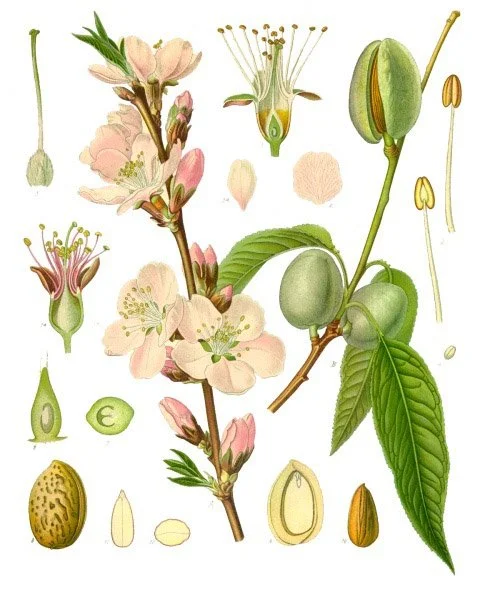
The Almond belongs to the same group of plants as the rose, plum, cherry and peach, being a member of the tribe Prunae of the natural order Rosaceae. The genus Amygdalus to which it is assigned is very closely allied to Prunus (Plum) in which it has sometimes been merged; the distinction lies in the fruit, the succulent pulp attached to the stone in the plum (known botanically as the mesocarp) being replaced by a leathery separable coat in the almond which is hard and juiceless, of a dingy green tinged with dull red, so that when growing it looks not unlike an unripe apricot. When fully ripe, this green covering dries and splits, and the Almond, enclosed in its rough shell (termed the endocarp) drops out. The shell of the Almond is a yellowish buff colour and flattened-ovoid in shape, the outer surface being usually pitted with small holes; frequently it has a more or less fibrous nature. Sometimes it is thin and friable (soft-shelled Almond), sometimes extremely hard and woody (hard-shelled Almond). The seed itself is rounded at one end and pointed at the other, and covered with a thin brown, scurfy coat. The different sorts of Almonds vary in form and size, as well as in the firmness of the shell. The fruit is produced chiefly on the young wood of the previous year, and in part on small spurs of two and three years growth.
The tree is of moderate size, usually from 20 to 30 feet high, with spreading branches the leaves lance-shaped, finely toothed (or serrated) at the edges. The flowers are produced before the leaves - in this country early in March; and in great profusion. There are two principal forms of the Almond the one with entirely pink flowers, Amygdalus communis, var. dulcis, producing Sweet Almonds; the other, A. communis, var. amara, with flowers slightly larger, and the petals almost white towards the tips, deepening into rose at the base, producing Bitter Almonds. Botanically, they are considered merely variations of the one type, and the difference in variety has been supposed originally to be mainly owing to climate, the Bitter Almond being a native of Barbary. The Sweet Almond is the earliest to flower, and is cultivated more largely than the Bitter Almond. It is valuable as a food and for confectionery purposes, as well as in medicine, being rich in a bland oil, and sustaining as a nutriment: the staying power conferred by a meal of Almonds and raisins is well known. It is only the Bitter Almond in the use of which caution is necessary, especially with regard to children, as it possesses dangerous poisonous properties.
(credit: A Modern Herbal, Volumes 1 & 2 by Margaret Grieve)
Garden Use:
Culinary | Medicinal
Growing Notes:
h
Exerpt from Ellacombe:
ALMOND
"An Almond for a parrot" seems to have been a proverb for the greatest temptation that could be put before a man. The Almond tree is a native of Asia and North Africa, but it was very early introduced into England, probably by the Romans. It occurs in the Anglo-Saxon lists of plants, and in the "Durham Glossary" (11th century) it has the name of the "Easterne nutte-beam." The tree was always a favourite both for the beauty of its flowers, which come very early in the year, and for its Biblical associations, so that in Shakespeare's time the trees were "in our London gardens and orchards in great plenty" (Gerard). Before Shakespeare's time, Spenser had sung its praises thus--
"Like to an Almond tree ymounted hye
On top of greene Selinis all alone
With blossoms brave bedecked daintily;
Whose tender locks do tremble every one
At everie little breath that under Heaven is blowne."
F. Q., i. 7, 32.
The older English name seems to have been Almande--
"And Almandres gret plente,"
Romaunt of the Rose;"Noyz de l'almande, nux Phyllidis,"
ALEXANDER NECKAM;
and both this old name and its more modern form of Almond came to us through the French amande (Provençal, amondala), from the Greek and Latin amygdalus. What this word meant is not very clear, but the native Hebrew name of the plant (shaked) is most expressive. The word signifies "awakening," and so is a most fitting name for a tree whose beautiful flowers, appearing in Palestine in January, show the wakening up of Creation. The fruit also has always been a special favourite, and though it is strongly imbued with prussic acid, it is considered a wholesome fruit.
By the old writers many wonderful virtues were attributed to the fruit, but I am afraid it was chiefly valued for its supposed virtue, that "five or six being taken fasting do keepe a man from being drunke" (Gerard).[12:1] This popular error is not yet extinct. As an ornamental tree the Almond should be in every shrubbery, and, as in Gerard's time, it may still be planted in town gardens with advantage. There are several varieties of the common Almond, differing slightly in the colour and size of the flowers; and there is one little shrub (Amygdalus nana) of the family that is very pretty in the front row of a shrubbery. All the species are deciduous.
FOOTNOTES:
[12:1] "Plutarch mentions a great drinker of wine who, by the use of bitter almonds, used to escape being intoxicated."--Flora Domestica, p. 6.